IEA Aspire: National Intern Day
Empowering Our Interns to Solve Real-World Challenges
When municipal intern Olohitare (‘Tare) Ojo started working on the Dallas Water Utilities (DWU) Replacement and Rehab of Wastewater project this summer, she quickly discovered that real world engineering rarely follows classroom rules. While searching for old records, she found that “most of the utilities were built decades ago, so a lot of the information wasn’t properly recorded back then.” In a university classroom, engineering problems come neatly packaged with clear rubrics and data sets. But navigating constraints on projects like DWU have proven that the true shift from the classroom to the field is all about adaptability, a lesson which lies at the heart of the IEA Aspire Program.
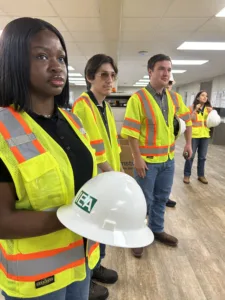 As an incoming college junior at Texas Tech University, IEA serves as ‘Tare’s first internship. Over this summer, she has gotten hands-on experience that will serve as a bridge between her past foundational coursework and her future, major-specific classes.
Beyond learning technical skills, what ‘Tare enjoys the most about being a part of the Municipal department is how she contributes to people’s day-to-day lives. As she puts it, “whether it’s a water resource or infrastructure project, it contributes to things people rely on every day.”
When working on these different projects, ‘Tare notes that she must “consider client requests, design standards, and collaborating with other departments.”
Learning to juggle all these different responsibilities was a learning curve shared by fellow municipal intern, Petra Klepetko, who also spent her summer discovering how public infrastructure shapes everyday life.
Petra has found her time at IEA to “invigorate [her] passion for civil engineering,” as she gets to see her work go into these projects.
As a municipal intern, Petra frequently collaborates with other departments. Specifically, for her, she has gotten to ask questions and talk with transportation and roadway engineers. For example, Petra described AnnaMarie Tomczyk, PE, as “one of our best transportation engineers. She’ll explain things to me that I don’t understand when it comes to the actual heavy design parts of projects.”
For AnnaMarie, Petra’s drive to continuously ask questions, seek out work, and quickly grasp concepts is exactly what sets Petra apart as a rising engineer. “We’re busy, so we like it when you come to us when you need help or to complete the assignment we gave you. It helps all our projects move along faster,” AnnaMarie shares.
Beyond the Municipal department, interns in other disciplines tackled entirely different learning curves. Roadway intern, Victor Guevara, came to IEA with two previous construction focused internships under his belt but was eager to get the chance to master the technical design side of civil engineering. “My first internship was 100% on the field. My second internship was four days on the field and one in the office, but it wasn’t enough time for me to feel confident in my design skills yet,” Victor shared.
At IEA, Victor was given the chance to refine his technical skills. “A task that used to take me an hour or two before, I’m now able to get done within 20 minutes after learning all the different programs,” Victor shared.
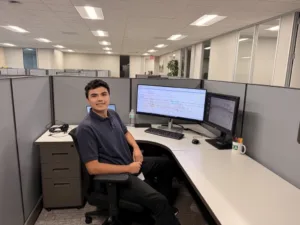 Working on active projects has required him to rely heavily on his own engineering intuition. When designing a portion of Harris County’s Atascocita Area Trails, Victor noticed a six-foot elevation in the terrain that wasn’t accounted for. Recognizing this issue, he proposed adding a retaining wall to his supervisor, Hua Liu, PE, who agreed with him, saving hours of potential redesign work. These moments demonstrate the problem-solving skills Victor has had to grasp as he dived into the design process compared to his previous field work.
As Victor prepares for his senior year at Texas A&M University, his active design experience has given him a new appreciation for the human element of engineering. He noted that his time at IEA will directly shape his upcoming engineering ethics courses, giving him “very specific examples to look back upon” of how design choices directly impact local communities.
Overcoming these different types of constraints is exactly what makes civil engineering so rewarding, especially when you get to see your work directly impacting local spaces. More than anything, this summer has been defined by adaptability. Each intern learned to navigate unfamiliar environments, embrace unexpected challenges, and push themselves out of their comfort zones.
The neat instructions of a university syllabus won’t teach you the dynamic problem-solving that’s required on the job, and these experiences are exactly what the IEA Aspire Internship Program provides for the next generation of engineers.